AI vs. Machine Learning vs. Deep Learning: What's the Difference?
These three terms get used interchangeably, but they're not the same thing. Here's a plain-English breakdown of how AI, machine learning, and deep learning actually relate to each other.
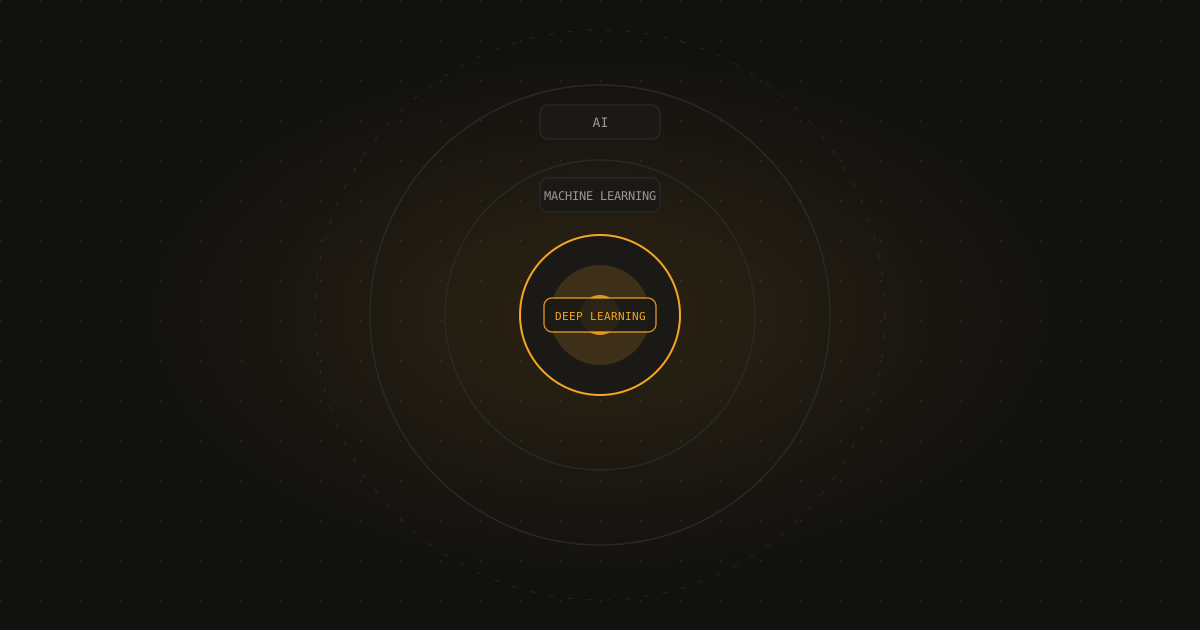
The short answer: AI is the broad goal — machines doing things that normally need human intelligence. Machine learning is one way to get there: instead of hand-coding every rule, the system learns patterns from data. Deep learning is a specific machine learning technique, using layered neural networks, and it’s the technique behind nearly every AI tool you’ve actually used, including ChatGPT, Claude, and Gemini.
These three terms show up constantly in AI news and marketing, often used as if they mean the same thing. They don’t. They’re nested inside each other, like three circles of decreasing size — and understanding the nesting clears up a lot of confusion.
Think of it as three nested circles
Artificial intelligence is the outermost circle: the general field and goal of building machines that can do things we’d normally say require intelligence — understanding language, recognising images, making decisions, solving problems.
Machine learning is a circle inside that one: a specific approach to building AI, where instead of programmers writing explicit rules for every situation, the system is shown large amounts of data and learns the patterns itself.
Deep learning is a circle inside machine learning: a specific family of techniques that uses neural networks with many layers (“deep” refers to the number of layers) to learn especially complex patterns. It’s the technique that made the current generation of AI possible.
Artificial intelligence: the broad idea
AI as a field goes back to the 1950s and includes a huge range of approaches, not all of which involve learning from data at all. Early AI systems were often rule-based: programmers wrote out explicit logic (“if this, then that”) to handle specific situations. A simple chess program that follows hand-coded strategies is AI, even though it never “learns” anything in the way modern systems do.
The defining feature of AI, in other words, isn’t the method — it’s the goal: getting a machine to do something that would normally require human-level judgement, perception, or reasoning.
Machine learning: how most modern AI actually works
Machine learning flips the approach. Instead of writing rules by hand, you feed a system a large amount of data and let it find the patterns itself. Show a machine learning system thousands of labelled photos of cats and dogs, and it learns to distinguish them — without anyone writing a rule like “if it has pointy ears and whiskers, it’s probably a cat.”
This matters because some problems are too complex or fuzzy for hand-written rules to handle well. Language, image recognition, and recommendation systems are all areas where machine learning vastly outperforms rule-based approaches, because the patterns involved are too intricate to specify by hand.
Deep learning: the technique behind the current AI boom
Deep learning is a specific kind of machine learning that uses artificial neural networks with many layers, loosely inspired by how neurons in the brain connect to each other. Each layer learns to recognise increasingly abstract patterns — in an image-recognition network, early layers might detect edges and colours, while deeper layers detect shapes, then objects, then entire scenes.
The “large” in large language model refers to the scale of this kind of network — billions of parameters (the adjustable values the network tunes during training) arranged in many layers. This is the technique behind ChatGPT, Claude, Gemini, Midjourney, and essentially every AI tool that’s made headlines in the past few years. (For more on how this works specifically for text-based AI, see what is a large language model.)
Where does “generative AI” fit in?
“Generative AI” isn’t a fourth nested circle — it’s a description of what the system does, not how it was built. A generative AI model (like the ones behind ChatGPT or Midjourney) is a deep learning system trained to create new content — text, images, audio — rather than just classify or predict. So a single AI tool is typically all four things at once: it’s AI (the goal), built using machine learning (the approach), specifically deep learning (the technique), and used generatively (the function).
Why the distinction barely matters day to day
If you’re using AI tools rather than building them, the practical takeaway is simple: when someone says “machine learning” or “deep learning,” they’re usually describing the engineering underneath an AI product, not a different category of product. You don’t need to track which term applies to which tool to use any of them well — but it’s useful vocabulary for understanding what people actually mean when they talk about how AI works under the hood.
Related: What is a large language model? and what is an AI agent?
Frequently asked questions
What’s the difference between AI, machine learning, and deep learning? Artificial intelligence is the broad goal of getting machines to do things that normally require human intelligence. Machine learning is one approach to that goal, where a system learns patterns from data instead of being given explicit step-by-step instructions. Deep learning is a specific technique within machine learning that uses layered neural networks, and it’s the technique behind most of today’s most capable AI, including the models behind ChatGPT, Claude, and Gemini.
Is ChatGPT machine learning or deep learning? Both, in the sense that deep learning is a type of machine learning. ChatGPT is built on a deep learning architecture (a large language model made of neural networks), which itself is a machine learning approach, which itself falls under the broader umbrella of artificial intelligence.
Do I need to understand this to use AI tools? No. You can use ChatGPT, Claude, or Gemini effectively without ever thinking about the difference between machine learning and deep learning, the same way you can drive a car without understanding combustion engines. It’s useful background if you want to follow AI news intelligently, but it has no bearing on day-to-day use.
Is all AI machine learning? No. Some AI systems are built from hand-written rules rather than learned from data — for example, older chess engines or simple rule-based chatbots. These are still “AI” in the broad sense, just not machine learning. Most of the AI tools people use today, though, are machine learning systems, and specifically deep learning ones.
Free newsletter
Join readers learning AI from zero
One plain-English AI tip per week. No jargon, no hype, no spam. Unsubscribe anytime.