What Is an AI Agent? (And How Is It Different from a Chatbot?)
AI agents are everywhere in 2026 tech conversations. Here's what actually separates an agent from a regular chatbot, with real examples of what agents can do.
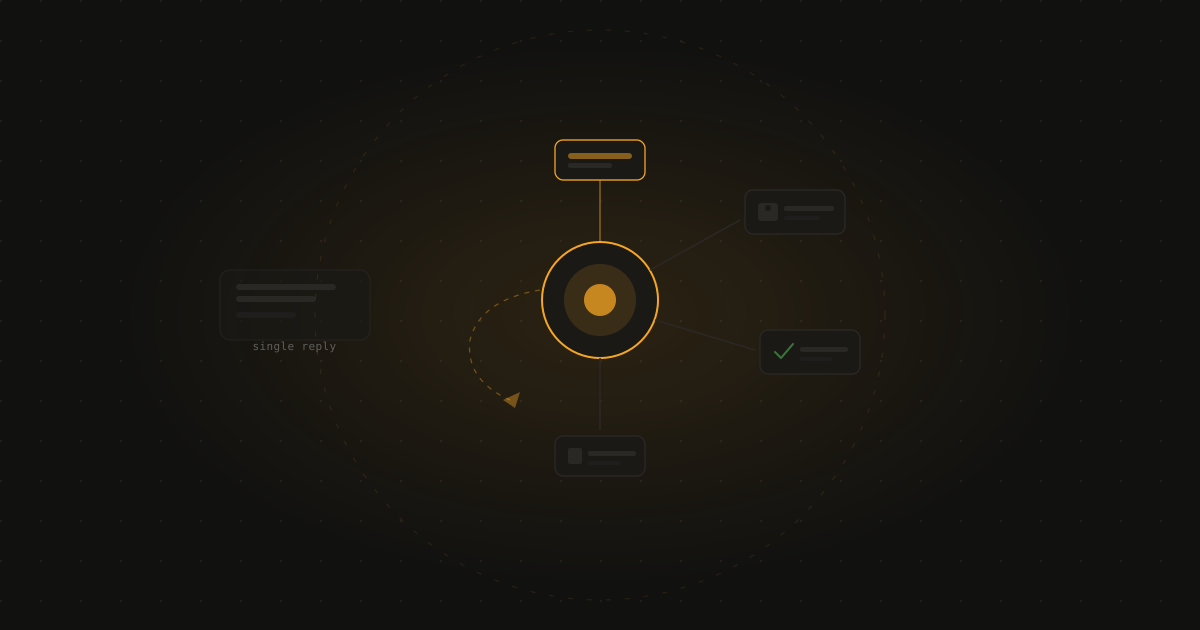
The short answer: An AI agent is an AI system that doesn’t just answer your question — it takes a goal, breaks it into steps, uses tools to carry those steps out, and keeps working until the job is done. A chatbot has a conversation with you. An agent does work for you.
“AI agent” has become one of the most-used phrases in AI conversations, and it’s also one of the most confusing — partly because companies use the term loosely, and partly because the line between “smart chatbot” and “agent” is genuinely blurry. Here’s a plain-English breakdown.
The core difference: answering vs. acting
A regular AI chatbot — the kind most people are used to — works in a simple loop: you type a message, it generates a response, and the interaction is complete. If you want it to do something else, you have to ask again.
An AI agent works differently. You give it a goal, and it figures out the steps needed to achieve that goal, carries them out — often using external tools like web search, code execution, or file access — checks whether it’s making progress, and adjusts if something doesn’t work. It keeps going across multiple steps without you having to prompt each one individually.
A simple analogy: a chatbot is like asking a knowledgeable friend a question. An agent is more like asking a capable assistant to handle a task — they go off, do the legwork, and come back when it’s done (or when they need a decision from you).
What makes something “agentic”
A few capabilities tend to define agent-like AI systems:
Planning. The AI breaks a goal down into a sequence of steps rather than producing one response.
Tool use. The AI can use external tools — searching the web, running code, reading and writing files, calling other software — rather than relying only on what it already knows.
Multi-step execution. The AI carries out several actions in sequence, using the results of one step to inform the next.
Self-correction. If something doesn’t work — a search returns nothing useful, code throws an error — the agent can recognise that and try a different approach, rather than simply failing.
Limited autonomy. The AI works somewhat independently within a task, rather than waiting for a new instruction after every single action.
Real examples of AI agents
Coding agents. Tools that can write code, run it, see if it works, fix errors, and repeat — completing a programming task across many steps rather than producing a single code snippet.
Research agents. Given a research question, an agent can search multiple sources, read through results, synthesise findings, and compile a structured report — handling the multi-step research process rather than answering from memory alone.
Computer-use agents. Some AI systems can now control a computer directly — clicking buttons, filling in forms, navigating between applications — to complete tasks that would otherwise require a human at the keyboard.
Customer service agents. Beyond answering FAQ-style questions, these can look up account details, process certain requests, and escalate to a human when needed — handling a full interaction rather than a single response.
Why this term is suddenly everywhere
A few things converged to make “AI agent” the buzzword of the moment. The underlying language models got better at multi-step reasoning and planning. Tool use (letting an AI search the web or run code) became standard. And AI companies started marketing “agentic” capabilities heavily, because moving from “answers questions” to “does tasks” is a meaningfully bigger value proposition for paying customers.
The result is that “agent” gets applied loosely — sometimes to genuinely autonomous multi-step systems, sometimes to features that are really just a chatbot with a few tools bolted on. When evaluating a product that claims to be “agentic,” the useful question is: does it actually take multiple independent actions toward a goal, or does it still need a new prompt for every step?
Should you be using AI agents?
If you’re a casual user asking ChatGPT or Claude questions and getting writing help, you don’t need to think about this much — that’s chatbot use, and it’s the right tool for those tasks.
Agents become useful when you have a multi-step task you’d rather delegate entirely: “research this topic and write me a report,” “go through these 50 files and rename them by date,” “find me three flight options under $400 and summarise the trade-offs.” If your AI tool supports agent-style features (many now do, often labelled things like “deep research,” “computer use,” or “agent mode”), they’re worth trying for tasks like these — just review the output, since more autonomy also means more opportunity for the AI to go in a direction you didn’t intend.
Related: What is a large language model? and what is prompt engineering?
Frequently asked questions
What is an AI agent? An AI agent is an AI system that can take actions to accomplish a goal, not just answer questions. Instead of responding to a single prompt, an agent can plan a sequence of steps, use tools (like browsing the web, running code, or controlling software), check its own progress, and keep working until the task is done or it needs your input.
What is the difference between a chatbot and an AI agent? A chatbot responds to what you say — you ask, it answers, the conversation ends there. An agent can act on your behalf: it can break a goal into steps, use tools to gather information or take actions, evaluate the results, and continue working autonomously toward a goal across multiple steps, often without you prompting each individual step.
What can AI agents actually do? Practical examples include: researching a topic across multiple sources and compiling a report, writing and testing code over several iterations, managing files and folders on a computer, booking tasks across multiple websites, and handling multi-step customer service workflows. The common thread is multi-step autonomy rather than a single question-and-answer exchange.
Are AI agents safe to use? Reputable AI agent products include safeguards — asking for confirmation before risky actions like making purchases or sending messages, and limiting what systems they can access. As with any AI tool, it’s sensible to start with low-stakes tasks, review what the agent did, and avoid giving agents access to sensitive accounts or irreversible actions until you trust how they behave.
Free newsletter
Join readers learning AI from zero
One plain-English AI tip per week. No jargon, no hype, no spam. Unsubscribe anytime.