What Is a Large Language Model? A Plain-English Explanation
ChatGPT, Claude, and Gemini are all built on large language models — but what does that actually mean? Here's a clear explanation with no technical jargon required.
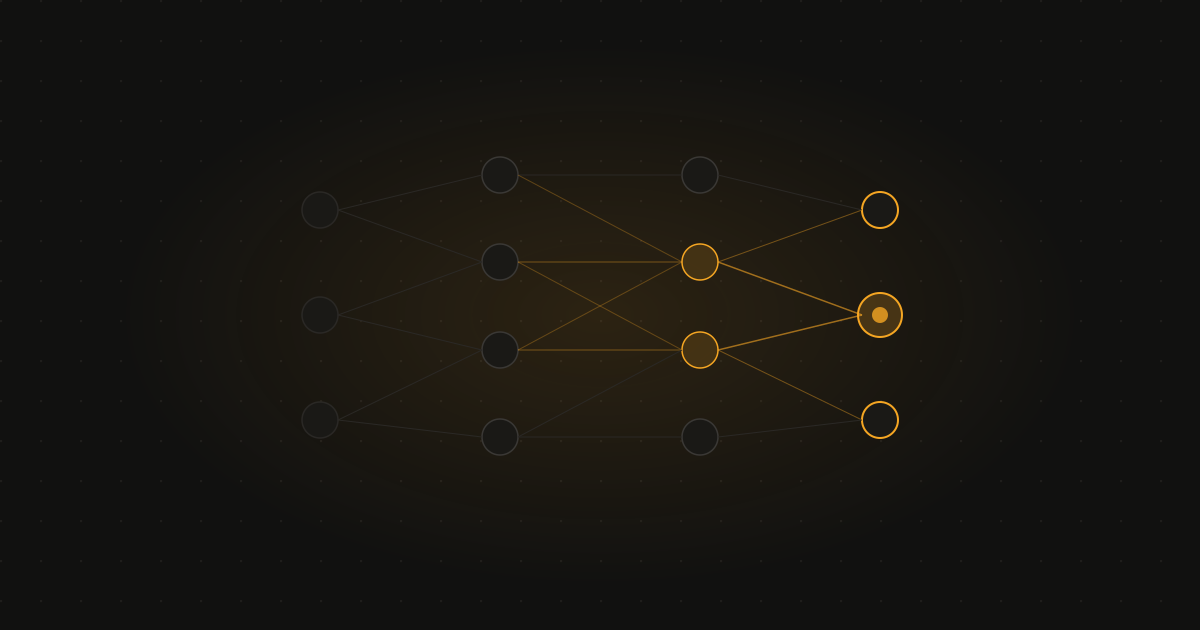
The short answer: A large language model (LLM) is the technology underneath AI assistants like ChatGPT, Claude, and Gemini. It’s a type of AI trained on enormous amounts of text that learned to understand and generate human language. You don’t need to know how it works to use AI tools — but if you’re curious, here’s the plain-English version.
You’ve probably seen the acronym LLM thrown around in AI coverage and wondered what it actually means. It’s one of those terms that sounds more complicated than it is. Here’s the straightforward explanation.
What a large language model is
A large language model is a type of artificial intelligence trained specifically to work with language — reading it, understanding it, and generating it.
The “large” part refers to scale: these models are trained on staggering amounts of text. We’re talking about hundreds of billions of words — books, websites, scientific papers, news articles, forum discussions, and much of the publicly available written internet. The training process takes months and requires enormous computing power.
The “language model” part describes what it learned to do: predict what text should come next in a sequence. At its core, an LLM learns patterns in language so thoroughly that it can generate coherent, contextually appropriate text in response to almost any input.
How it actually works (the simple version)
Imagine you read every book, article, and website ever written. You’d develop an incredibly deep intuition for how language works — which words follow which, how arguments are structured, what a polite refusal sounds like versus an enthusiastic yes, how to explain a concept at different levels of complexity.
An LLM develops something like that intuition, but through statistical patterns across billions of examples rather than human understanding. It doesn’t “know” things the way you know things — it recognises patterns in how language works and uses those patterns to generate responses that make sense.
When you type a message into ChatGPT, the model processes your input, recognises patterns that relate to it, and generates a response word by word — each word chosen based on what’s statistically most likely to be appropriate given everything before it. The result feels like understanding because the patterns are so deeply learned.
The difference between the model and the product
This is a distinction that causes a lot of confusion.
The LLM is the underlying technology — the trained model itself. Examples: GPT-4o (OpenAI), Claude 3.5 Sonnet (Anthropic), Gemini 1.5 Pro (Google), Llama 3 (Meta).
The product is what you interact with. Examples: ChatGPT, Claude.ai, Google Gemini, Microsoft Copilot.
The product wraps the LLM with a user interface, safety guidelines, memory features, and other functionality. ChatGPT is the car. GPT-4o is the engine. You interact with the car — the engine is what makes it go.
The same LLM can power different products. Microsoft Copilot, for instance, is built on OpenAI’s models. Different companies can also use the same underlying model family with different fine-tuning, which is why products built on similar technology can feel quite different to use.
Why they’re called “large”
Size matters with these models, which is why “large” is in the name.
Larger models — trained on more data, with more parameters (the internal variables the model adjusts during training) — generally produce better, more accurate, more nuanced outputs. A model with hundreds of billions of parameters handles complex reasoning and subtle language better than a smaller one.
This is why there’s a free tier and a paid tier for most AI tools: the paid tier gives you access to a larger, more capable model. The free tier runs a smaller, faster, cheaper model that’s good enough for many tasks but has real limitations on complex ones.
What LLMs are good and bad at
Good at:
- Generating coherent, contextually appropriate text
- Summarising and rewriting content
- Answering questions based on their training data
- Following complex instructions
- Working across many languages and domains
Not good at:
- Knowing what happened after their training cutoff
- Maths and precise reasoning (they can make numerical errors)
- Verifying facts in real time (they don’t search the internet unless specifically connected to a tool that does)
- Remembering information between separate conversations
This is why AI tools can confidently state things that are wrong — the model is generating plausible-sounding text based on patterns, not looking things up and verifying them. It’s the root cause of AI hallucination.
Do you need to know any of this?
Honestly, no. You can use ChatGPT, Claude, and every other AI assistant without understanding anything about how LLMs work — just like you can use Google without understanding how search indexing works.
But understanding the basics helps explain the limitations. When ChatGPT doesn’t know about something that happened last month, that’s the training cutoff. When it confidently states something wrong, that’s the pattern-matching nature of the model. When the paid version is noticeably smarter than the free one, that’s model size.
It makes the tools less mysterious and helps you use them more sensibly.
Curious about a specific AI tool? See what is ChatGPT, what is Claude AI, or what is Google Gemini for plain-English breakdowns of each.
Frequently asked questions
What is a large language model in simple terms? A large language model (LLM) is a type of AI trained on vast amounts of text — books, websites, articles, and more — to understand and generate human language. When you type something into ChatGPT or Claude, an LLM is what reads your message and writes the response.
What are examples of large language models? The most well-known large language models include GPT-4 (which powers ChatGPT), Claude (made by Anthropic), Gemini (made by Google), and Llama (made by Meta). Each is trained differently and has different strengths, but they all work on the same fundamental principles.
Is ChatGPT a large language model? ChatGPT is an AI assistant built on top of a large language model called GPT-4 (and newer versions). The LLM is the underlying technology — ChatGPT is the product you interact with. Think of the LLM as the engine and ChatGPT as the car.
Do I need to understand LLMs to use AI tools? Not at all. You don’t need to know how a large language model works to use ChatGPT, Claude, or any other AI tool — just like you don’t need to understand how a search engine works to use Google. This explanation is for people who are curious, not a requirement for using the tools.
Free newsletter
Join readers learning AI from zero
One plain-English AI tip per week. No jargon, no hype, no spam. Unsubscribe anytime.