What Is AI Hallucination? (And Why It Matters)
AI tools sometimes state wrong information with total confidence. This is called hallucination. Here's what causes it, why it matters, and how to protect yourself from it.
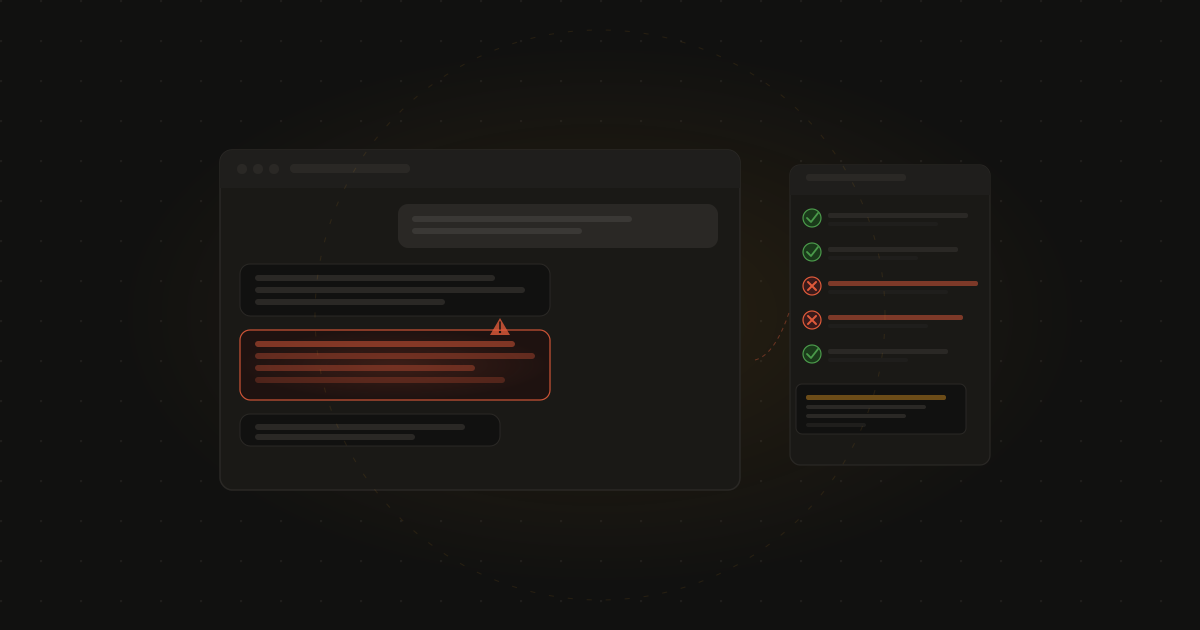
The short answer: AI hallucination is when an AI tool confidently states something that is false. It’s not a bug in the traditional sense — it’s a fundamental characteristic of how current AI language models work. The AI doesn’t know the difference between what it’s confident in and what it’s making up. Understanding this helps you use AI more safely and effectively.
If you’ve used ChatGPT, Claude, or other AI tools for more than a few minutes, you may have noticed something unnerving: the AI can be completely wrong about something while sounding completely certain.
It might cite a research paper that doesn’t exist. It might get a historical date wrong. It might give you a statistic with two decimal places that is entirely fabricated. And it does this with the same confident, fluent tone it uses when it’s right.
This is called hallucination, and understanding it is one of the most important things you can know about using AI.
Why does hallucination happen?
To understand hallucination, it helps to understand what AI language models actually do.
These models — the technology behind ChatGPT, Claude, and Gemini — don’t think the way humans do. They don’t look things up, reason from evidence, or verify claims against facts. Instead, they are trained on enormous amounts of text and learn to predict: given this sequence of words, what should come next?
This prediction process is extraordinarily good at producing fluent, coherent, relevant-sounding text. But it has a fundamental limitation: the model doesn’t have a built-in fact-checking step. It produces text that sounds right based on patterns in its training data, not text that it has verified is right.
When you ask it about something well-documented that appeared frequently in its training data, it usually gets it right. When you ask about something obscure, specific, recent, or ambiguous — it might produce a confident-sounding answer that is partly or entirely wrong.
The term “hallucination” comes from the idea that the AI is perceiving or generating something that isn’t really there.
What kinds of things does AI get wrong?
Citations and references. This is one of the most documented hallucination patterns. Ask an AI to cite academic papers, and it will sometimes produce plausible-sounding but completely fabricated paper titles, journal names, and author combinations. The papers don’t exist. The citations look real.
Specific statistics and numbers. AI is particularly unreliable when it comes to precise figures. It might state that “47.3% of people do X” — a number invented with false precision. Always check statistics against an actual source.
Historical dates and details. The broad strokes are usually right; the specific details are more prone to error. “The battle was in 1645” might be wrong in a way that confidently sounds right.
Quotes. Ask an AI for a quote from a famous person and it may produce something they never said — worded plausibly enough to be convincing.
Recent events. AI models have a training cutoff date and don’t have real-time information. Ask about something that happened after their training ended and they may either say they don’t know (good) or confabulate an answer (bad).
Obscure or niche facts. The less something appeared in training data, the higher the hallucination risk. Well-known public figures and major historical events are safer. The CFO of a mid-sized company, a specific court ruling, or a local historical detail are more likely to produce errors.
Why this matters in practice
For casual use — brainstorming, writing help, explaining concepts, getting unstuck — hallucination is usually low stakes. If the AI suggests an outline for your essay and one bullet point is slightly off, you’ll catch it.
The stakes rise when you act on AI output without checking it. There have been documented cases of lawyers submitting briefs citing court cases that AI made up. Journalists publishing statistics that were fabricated. People making decisions based on AI-generated “facts” that turned out to be wrong.
If you share AI output publicly, use it to make important decisions, cite it in professional or academic work, or rely on it for anything where accuracy matters — you need to verify.
How to protect yourself
Verify specific claims. If AI gives you a statistic, a date, a name, or a citation — check it against an actual source before using it. This doesn’t mean checking everything; it means checking the things that matter and that are specific.
Use tools that cite sources. Perplexity AI, for example, provides links to the sources it draws from. This makes verification much faster — you can click through to the actual article or paper.
Ask the AI to express uncertainty. You can prompt: “Tell me where you’re less confident in this answer.” Good models will often flag their uncertainty honestly if asked.
Be more cautious on obscure topics. The less mainstream the topic, the more you should verify. AI is generally reliable on widely covered subjects and less reliable on niche ones.
Treat AI output as a first draft, not a final source. This mindset shift helps. AI is excellent at producing useful starting points. It is not a reference work.
Is hallucination getting better?
Yes. Each generation of models has become more accurate, and AI labs are investing heavily in reducing hallucination rates. Techniques like retrieval-augmented generation (where the AI looks things up rather than relying solely on its training) are improving accuracy for certain tasks.
But hallucination hasn’t been solved, and it may be an inherent limitation of how current language models work. The practical implication: AI tools are getting more reliable, but the appropriate response is calibrated trust — high for tasks where errors are low-stakes, higher scrutiny where accuracy matters.
Related: What is a large language model? and how to use AI for research
Frequently asked questions
What is AI hallucination? AI hallucination is when an AI model generates information that is false, fabricated, or inaccurate — but presents it with the same confidence as correct information. The AI isn’t lying deliberately; it’s predicting what text should come next based on patterns, and sometimes produces plausible-sounding but wrong content. The term ‘hallucination’ is used because the AI perceives something that isn’t there.
Why do AI models hallucinate? Large language models work by predicting the most statistically likely next word or sentence based on their training data. They don’t have a separate fact-checking mechanism — they generate text that sounds right rather than verifying information against a source. When asked about something outside their training data, or when the training data itself was incorrect, they can produce confident-sounding fabrications.
How common is AI hallucination? It varies by task and model. For well-established, frequently discussed topics, modern AI models are quite reliable. For specific details — exact dates, precise statistics, citations, obscure facts, recent events — hallucination is a real risk. Studies have found error rates ranging from 3% to 30%+ depending on the task, with factual question-answering and citation tasks being particularly prone.
How can I avoid being misled by AI hallucinations? The main safeguard is to verify specific factual claims — especially statistics, dates, citations, quotes, and anything you’ll act on or share publicly. Use AI for tasks where errors are low-stakes (drafting, brainstorming, explaining concepts) and apply more scrutiny when accuracy matters. Tools like Perplexity that cite their sources make verification easier. Never cite AI output directly in anything requiring factual accuracy without checking.
Free newsletter
Join readers learning AI from zero
One plain-English AI tip per week. No jargon, no hype, no spam. Unsubscribe anytime.